Our nationally certified NYSTART/CSIDD team helps people with intellectual and developmental disabilities and mental health needs prevent crises and remain safely in their communities.
The Arc Chemung-Schuyler leads a nationally accredited CSIDD/START program serving OPWDD Region 1 across Western New York, the Finger Lakes, and the Southern Tier. The program brings together people in crisis, their families, support teams, and hospital partners to prevent crises, reduce hospital admissions, and address the overdiagnosis of people with intellectual and developmental disabilities. A specialized clinical team—including a medical director, clinical director, program director, clinical coordinators, and therapeutic coaches—develops coordinated strategies that support lasting stability and better outcomes. Our team of experts has been nationally certified in delivering START services through the University of New Hampshire since 2014. This evidence-based model helps persons reduce crisis situations that result in fewer emergency room visits and hospital stays.
Persons with intellectual and developmental disabilities (IDD) and mental health (MH) issues who present to emergency rooms in crisis can become a significant challenge for hospital settings leading to issues of discharge delays creating bed shortages and increased medical costs. In some hospitals, these complex care cases result in a cost of $5,000 per person. What is needed is a comprehensive system of supports throughout the entire service delivery system. For people with IDD and MH, a hospital stay can continue long after treatment is complete because appropriate housing, community services, staffing, funding, or discharge approvals are unavailable. Being stuck in a hospital can separate people from family, routines, work, school, and community life; limit choice, movement, learning, and social connection; and lead to lost skills, reduced independence, and greater support needs. Disability-related needs and behaviors may also be misunderstood. The central challenge is not the person’s disability, but a fragmented system in which hospitals, state agencies, insurers, courts, and community providers operate under different rules and often lack the capacity to coordinate a timely, person-centered transition. People with IDD need crisis prevention, early discharge planning, flexible community-based services, and one coordinated plan that respects their rights, preferences, dignity, safety, and choice to live in the most integrated setting.
The national START model—Systemic, Therapeutic, Assessment, Resources, and Treatment—offers a coordinated solution for people age six and older with intellectual and developmental disabilities and mental health needs. Rather than waiting for a crisis to escalate, START strengthens the person’s entire system of support through comprehensive assessment, cross-system planning, clinical consultation, training, family education, community linkages, and short-term therapeutic resources. Its person-centered crisis prevention and intervention plan gives families, providers, hospitals, and public agencies a shared roadmap for recognizing risks early, responding consistently, and helping the person remain safely in the community whenever possible. By building local capacity and coordinating care across systems, START addresses the fragmentation that contributes to repeated emergency department visits, psychiatric hospitalization, and delayed discharge while promoting stability, independence, and community inclusion.
Program data show that START/CSIDD is helping people achieve greater stability while relying less on emergency and inpatient care. In the year before enrollment, nearly one in four people with intellectual and developmental disabilities and complex mental health needs visited a psychiatric emergency room. After enrollment, that rate fell to fewer than one in ten, with emergency department use declining even more sharply. The team is also stabilizing crises more quickly and reducing overall hospital stays. These outcomes demonstrate how coordinated crisis planning, therapeutic coaching, and consistent support across home, provider, and clinical settings can improve safety, preserve community living, and enhance quality of life.
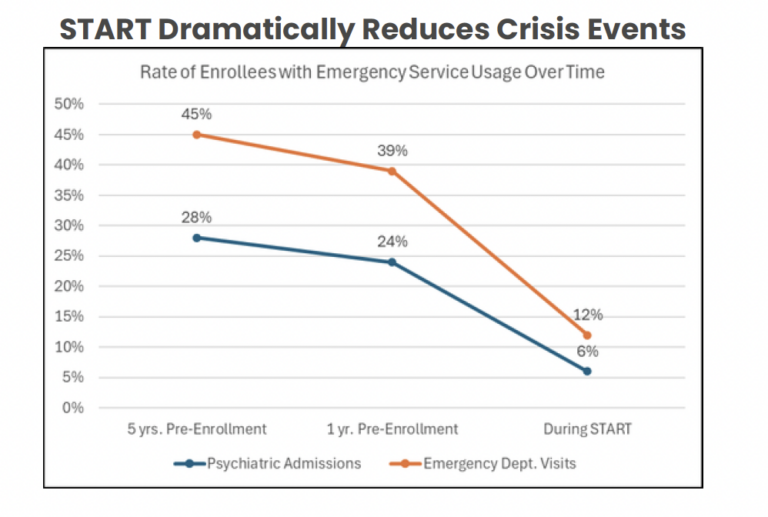
START/CSIDD outcomes show substantial reductions in psychiatric emergency room use and emergency department visits after enrollment.
Chelsea Borowski directs The Arc’s NYSTART/CSIDD crisis program across OPWDD Region 1 and serves on the agency’s Executive Management Team. She educates community partners about the START model, builds the capacity of provider agencies and community systems, and strengthens collaboration across systems for people with IDD and complex mental health needs.
Dr. Rose Hazlitt is a New York State Licensed Psychologist who brings more than 15 years of experience supporting people with IDD and behavioral health needs to The Arc’s crisis services. She is certified in the START model, a research-informed approach that emphasizes biopsychosocial assessment, trauma-informed care, strength-based approaches and solution-focused intervention.
The Arc Chemung-Schuyler is partnered with the University of New Hampshire’s University Center for Excellence in Developmental Disabilities as a certified partner of the national START program.
The National Center for START Services® (NCSS) is an initiative that works to strengthen efficiencies and service outcomes for people with IDD and mental health needs in the community. NCSS was established at the University of New Hampshire Institute on Disability in 2011 to provide technical assistance, clinical expertise, training, and consultation services that support the development of:

Assistive and remote support technology that helps people with intellectual and developmental disabilities live more independently at home, at work, in school, and in the community.

A pilot pairing barcoded, person-centered meals with smart ovens so more people can take part in preparing their own food.